
Successful Generation of Syngas as Chemical Feedstock from Used "Okusuri Sheet"
—Enabling Closed-Loop Recycling of "Okusuri Sheet" into Packaging Materials through Innovative Chemical Recycling Technology—
JFE Engineering Corporation
Daiichi Sankyo Healthcare Co., Ltd. (Head Office: Chuo-ku, Tokyo; President: Takahiro Uchida; "Daiichi Sankyo Healthcare") and JFE Engineering Corporation (Head Office: Chiyoda-ku, Tokyo; President and CEO: Kazuyoshi Fukuda; "JFE Engineering") conducted a demonstration test ("the Test") to generate syngas as a chemical raw material from used plastics, including "Okusuri Sheet", a blister pack for medications used for tablets and capsules, and successfully achieved stable syngas generation
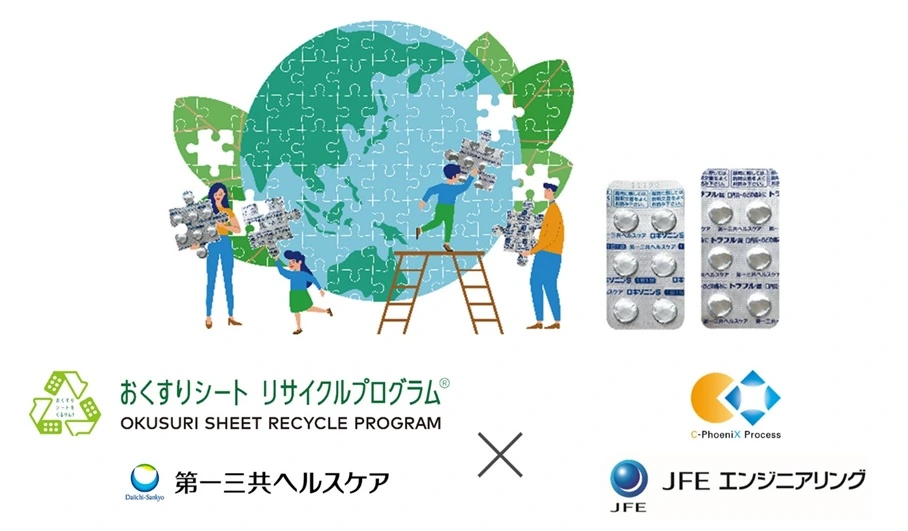
In the waste treatment sector, achieving both resource circulation and greenhouse gas emissions reductions is essential to realizing carbon neutrality by 2050. Conventionally, "Okusuri Sheet," widely used in pharmaceutical packaging, has been difficult to separate because it is a composite material composed of plastic and aluminum. As a result, most of it has been incinerated or collected as recyclable waste and subsequently processed through thermal recycling*1.
JFE Engineering has been developing chemical recycling technologies that convert used plastics, including composite materials, into chemical raw material for resource recovery. To verify whether these technologies can also be applied to recycling of "Okusuri Sheet," the Test was conducted.
In the Test, JFE Engineering applied its innovative waste gasification technology, "C-PhoeniX Process®"*2, to used plastics including "Okusuri Sheet" collected from consumers through Daiichi Sankyo Healthcare's Okusuri Sheet Recycling Program*3, successfully generating syngas (CO, CO₂, and H₂).
Overview of the Test
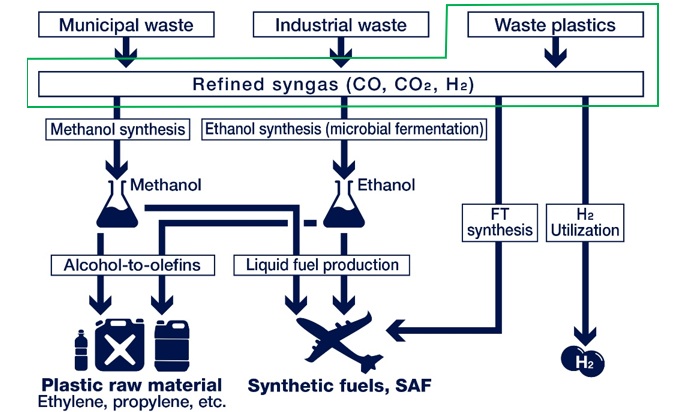
JFE Engineering aims to establish a comprehensive waste chemical recycling process that converts waste plastics (used plastics) into plastic raw material and other products via syngas. This Test verified, on a small-scale basis, the conversion of used plastics into r syngas (highlighted in green in the figure below), which forms part of the overall recycling workflow.
To further evaluate this technology as a new recycling option capable of accommodating increased collection volumes, we will continue conducting more detailed verification. Looking ahead, we aim to achieve commercial implementation through ongoing technology validation at a large-scale waste gasification plant currently planned for construction.
Leveraging the strengths of both companies, Daiichi Sankyo Healthcare and JFE Engineering will continue advancing initiatives aimed at establishing resource circulation for "Okusuri Sheet," a pharmaceutical packaging material that is difficult to reduce, thereby contributing to a sustainable society.
Comments from Project Team
Junya Iwaki, Sustainability Promotion Manager, Daiichi Sankyo Healthcare Co., Ltd.
This Test was made possible only through the cooperation of each participant who has supported the "Okusuri Sheet" Recycling Program to date. We want to express our sincere appreciation to all of you.
Since "Okusuri Sheet" is a composite material consisting of multiple types of plastics and aluminum, Daiichi Sankyo Healthcare has studied and demonstrated various recycling methods*1. However, we have found that material recycling*1 alone has limitations in terms of applications and processing capacity. In this context, we see great significance in this Test: it demonstrates the potential to utilize these materials effectively and we aim to advance our initiatives at a realistic pace, yet steadily, even as collection volumes grow.
Going forward, while working to expand collection areas, we will advance our initiatives step by step through two complementary pillars: creating more accessible collection systems for consumers and further evaluating recycling technologies. At a realistic pace, yet steadily, we hope to continue building a recycling practice rooted in everyday life, together with all of you.
Kenichi Okuyama, General Manager of the Environmental Business Development Center, JFE Engineering Corporation
This Test was conducted as part of a project commissioned by the New Energy and Industrial Technology Development Organization (NEDO), with support from the Ministry of the Environment and Chiba City. We would like to express our sincere gratitude for their support.
Through this Test, we confirmed that our waste gasification technology has the potential to recycle composite materials, such as "Okusuri Sheet," that are difficult to process via material recycling or other chemical recycling methods. JFE Engineering will continue to advance technology verification and accelerate efforts toward societal deployment in order to meet the recycling needs of a broader range of manufacturers and companies.
Company Profiles
Daiichi Sankyo Healthcare Co., Ltd.
Building on its strengths as a leading Over-the-Counter (OTC) drug company, Daiichi Sankyo Healthcare has expanded its business to include functional skincare, oral care, and food products. The company continues to grow as a total consumer healthcare company dedicated to supporting people's healthy lives.
Under the corporate slogan, "Fit for You – A Trusted Partner in Your Journey to Health and Well-being," the company is committed to empowering everyone to embrace self-care and self-medication.
JFE Engineering Corporation
JFE Engineering is a comprehensive engineering company engaged in the engineering, procurement, and construction (EPC) and operation of large-scale plants and steel structures in the environmental, energy, and infrastructure sectors. The Company is committed to advancing a circular economy and achieving carbon neutrality.
Guided by its corporate purpose, "Create, Care, Connect. The Foundations of Life — Just For the Earth," JFE Engineering will continue to contribute to the realization of a sustainable future by developing infrastructure that supports safe and secure living.
- *1Types of Recycling
There are three principal methods for recycling used plastics:(1) Thermal recycling: A method that recovers heat energy generated during incineration as electricity, hot water, or steam for efficient energy utilization. While this is the most widely used method in Japan, the material itself is not reused, and it generates CO₂ emissions.
(2) Material recycling: A method where plastics are remelted and remolded into new products for reuse. This approach is often subject to limitations regarding material purity and composition, making it difficult to apply to composite materials.
(3) Chemical recycling: A method that breaks down waste materials into chemical feedstocks, such as gases or oils, which are then reused as raw materials for chemical products or plastics. It is gaining attention as a viable solution applicable even to waste containing composite materials.
Material recycling and chemical recycling are expected to contribute to resource circulation and the realization of a decarbonized society by enabling waste to be closed loop recycled as resources. - *2 C-PhoeniX Process® (JFE Engineering)
This is JFE Engineering's world-class proprietary technology that enables the stable production of refined syngas—primarily composed of hydrogen (H₂) and carbon monoxide (CO)—from a wide variety of waste materials. It is expected to be applicable to various waste-to-chemical processes, including use as a raw material for plastics and SAF, as well as a hydrogen source. In addition to making a significant contribution to resource circulation and the realization of a circular economy, this innovative process can substantially lower CO₂ emissions by both mitigating emissions associated with waste treatment and reducing reliance on fossil-derived raw materials and fuels in downstream recycle applications.
In February 2024, the technology was selected for NEDO's Green Innovation Fund Projects, "Achieving Carbon Neutrality in Waste and Resource Circulation," and demonstration testing is currently underway. - *3Okusuri Sheet Recycling Program (Daiichi Sankyo Healthcare)
This is Japan's first* consumer-participation program for collecting and recycling used "Okusuri Sheet," aiming to establish a system that enables closed-loop resource circulation.
Launched in Yokohama City, Kanagawa, in October 2022, the program now operates over 100 collection points, including pharmacies, drugstores, hospitals, and public facilities. Following an expansion into Higashiyamato City, Tokyo, in December 2025, the total collection volume reached approximately 20 tons (equivalent to roughly 20 million Okusuri Sheets) as of the end of May 2026.
To date, collected "Okusuri Sheets" have been recycled via material recycling into products such as ballpoint pens, trays, and benches. However, the success of this Test opens new possibilities; beyond repurposing them into finished plastic goods, the sheets can now be reconverted into virgin plastic feedstocks, paving the way for true closed-loop recycling where they are reborn as new "Okusuri Sheets."
*Based on research by TerraCycle Japan GK (as of October 20, 2022).
![logotype[en_1].png](https://www.jfe-eng.co.jp/en/news/images/uploads/logotype%5Ben_1%5D.png)
For inquiries regarding this press release, please contact:
- Public Relations Section, General Administration Department, JFE Engineering Corporation